Investors have bet heavily hoping to find the next Tesla, but many EV groups are struggling to make the production process work.
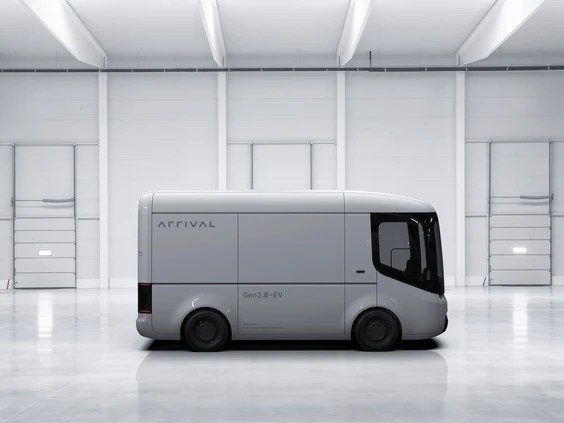
Just outside the English market town of Bicester, 15 miles from Oxford, lies the shell of a factory that sits at the forefront of the electric-vehicle revolution in the United Kingdom. Under a cavernous warehouse ceiling, dozens of gigantic black robotic arms sit poised over the vacant assembly bays, waiting to mass produce electric vans for Arrival Ltd., the EV maker startup.
By autumn, this pristine hub is supposed to begin producing electric vans for United Parcel Service Inc. But already the work is behind schedule. A sister plant in the United States will not be ready in time, and so the U.K. factory will have to shoulder the bulk of this year’s production. Arrival now expects to make just 600 vans this year, less than half the number it promised analysts during 2021.
The company is not alone. A plethora of electric vehicle maker wannabes — some opening factories for the first time, and many with steep valuations — are facing their biggest challenge yet: making vehicles. From China’s Nio Inc. to the Amazon.com Inc.-backed, one-time Wall Street darling Rivian Automotive Inc., almost every one of the auto world’s feisty new entrants has stumbled at this stage.
The industry’s shift to electric cars was always expected to lead to a deluge of new entrants, because the barriers to entry are so much lower on battery vehicles than on their engine-powered forebears. But the combination of Tesla Inc.’s helium-filled valuation and the market tolerance for lightly scrutinized reverse takeovers led to a stampede of EV businesses listing their shares.
As a result, companies with neither profit, nor in many cases even revenues, found themselves on public markets, squinting into the full glare of the world’s investment community. Canoo Inc., Lucid Group Inc., Nikola Corp., Lordstown Motors Corp., Fisker Inc., Arrival and Rivian were all among businesses that went public before shipping a single completed vehicle to a customer.
Yet investors piled in. At least 18 automakers have listed in the past two years through a special purpose acquisition company (SPAC), according to data from PitchBook, while Rivian completed an initial public offering. SPACs, also known as “blank-cheque companies,” have become a controversial backdoor way for a business to merge with an existing listed shell company and enter the public markets with far less disclosure than required in a traditional IPO.
The next 12 months will be critical in proving which, if any, were worth the risk. “These are still concept stocks,” Dan Levy, an automotive analyst at Credit Suisse Group AG, said. In addition to the pressures of igniting manufacturing, several companies including Lordstown, Canoo, Lucid and Nikola have disclosed they face or have faced federal investigations.
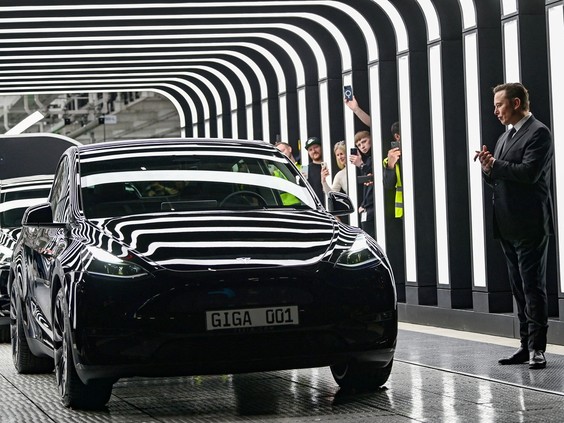
There is a timeless, undentable automotive truth: making vehicles is hard. The lesson was best demonstrated by Tesla, whose decade-long struggle towards mass production saw it grapple with pitfalls galore, from getting the right parts in time to assembling cars so that they did not leak when it rained.
In its darkest hour, the company went through what its chief executive Elon Musk called “production hell”: supplies were late or missed, cars came off the production line requiring extensive additional work. At one point, the company was turning out vehicles without seats and asking dealers to bolt them on in the showrooms.
Tesla has emerged from the other side of the saga as a trillion-dollar business. Investors are now hunting for a company that can emulate its success.
“People on Wall Street have already made the decision that we are going to (invest in) EVs, and they are looking for one, two or three companies that could be the next big success,” said Henrik Fisker, whose eponymous electric carmaker is one of the field’s latest entrants. “There is a belief that somebody or several (companies) could take an usually large chunk of the EV market, because the traditional companies won’t be ready or won’t have the product.
“(Investors) are not sure who it is,” Fisker added, “(so) they are betting on several, and seeing who will emerge.”
The ‘Musk effect’
Yet the euphoria is already beginning to wane. Shares that once valued truckmaker Rivian higher than Volkswagen Group and luxury group Lucid above Ford Motor Co. have lost more than half of their value in the past six months, a decline that set in far before the Russian invasion of Ukraine knocked all global auto stocks.
While the companies are still worth billions, and many are priced above the lowest-ranked incumbents such as Renault SA or Mazda Motor Corp., a tepid dose of realism has seeped into the previously ebullient sector.
“It’s very easy to look at what Tesla has done and say this is the formula, if you have the Tesla DNA, the Tesla mojo, you are going to succeed,” Credit Suisse’s Levy said. “But Tesla is unique in what it has done; just because Tesla did it, it’s not a guarantee that others can replicate its strategy.”
Tesla’s road to glory was also strewn with delays, with patient shareholders often building in a “Musk factor” by adding several months onto the latest timelines. The new wave of companies will enjoy far less leniency, especially since the market for electric vehicles is no longer the wide-open field that Tesla was able to dominate after established carmakers “quadrupled down on EVs,” Levy said.
“They won’t have the 10-year runway that the industry gave Tesla,” said Philippe Houchois, an auto analyst at Jefferies Group LLC in London.
The new entrants are already feeling the pressure. Rivian was initially seen as such a threat by America’s truckmakers that it was courted by both General Motors Co. and Ford, with the latter eventually succeeding in partnering with the group.
More recently, it suffered a backlash after raising prices on its models by up to a fifth and was forced to halve its production targets to 25,000 for this year, citing global supply chain problems.
Lucid, which is run by former Tesla and Lotus Cars Ltd. engineer Peter Rawlinson, pushed back the start of production last year by several months, saying it wants to get its first car “absolutely right.”
Mainstream carmakers from Volvo to Volkswagen have also tempered 2022 production forecasts, hemmed in by global chip shortages and disruption from the war in Ukraine. But the established industry groups have weathered such storms before, and have large, global operations that can shift and absorb such body blows.
The newer rivals are minnows by comparison, making them particularly vulnerable to global disruption.
“We all have an idea (of) what Elon’s hell looks like, and no desire to go there,” Karl-Thomas Neumann, a former VW and GM executive, said. “(Startups) wanted to disrupt, but have no idea how to disrupt manufacturing technology.”
Neumann’s career since leaving GM in 2017 has been a whistle-stop tour of the new hopefuls. He sat on the board of Evelozcity, which became Canoo, and advised blank-cheque group VecotIQ Acquisition Corp. on its merger with Nikola. Today, he is a board member at Polestar, the electric-vehicle spinoff from Volvo that plans to go public through a SPAC this year.
This nomadic experience has given Neumann a rare glimpse into the working cultures of several of the hopefuls.
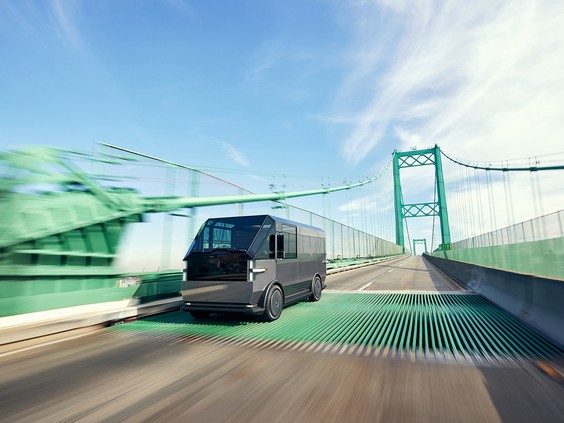
“The first thing I noticed at Canoo was everything is different, nothing that I learned before counted for anything anymore,” he said. “There were so many young engineers, they were super agile, jumping here and there, and not afraid of anything. We wanted a prototype and they did it in a week.”
Newer businesses are hoping that this nimbleness will translate into being able to launch vehicles faster and make changes more rapidly. But the atmosphere inside Canoo was “very chaotic,” Neumann said, with little planning or co-ordination. “For me, it was too much.”
For Tony Aquila, Canoo chief executive since April 2021, the priority is getting the group’s first factory, which is due to open in Oklahoma later this year, started.
“We are in the final round before we go to manufacturing,” he said after Canoo cut ties with a European contract manufacturer and shifted production to the U.S. “The building, the manufacturing side, is more important to me than anything.”
Escaping ‘manufacturing hell’
Some of the new players are turning to established names for help. Fisker’s first model is being made by Magna Steyr AG & Co. in Austria, in the same factory where the contract builder makes the BMW 5 Series estate and the Mercedes-Benz G-Class.
“It’s wrong for many of these startups to think the first thing they do is build a factory,” Neuman said. “They will all go to manufacturing hell.”
But outsourcing, even to an established expert, is no guarantee of success. Nio, the first Chinese EV maker to list back in 2018, contracted local carmaker JAC Motors to run its first plant, hoping to avoid the troubles that were ensnaring Tesla at the time. But the delays were such that when Nio filed its IPO documents in 2018, it had still only produced 400 cars in the first half of that year.
“It’s wrong for many of these startups to think the first thing they do is build a factory“
KARL-THOMAS NEUMANN
There are other risks attached to farming out production. Tesla benefited from its vertical integration, from making the batteries with Panasonic Corp. to producing its own software.
“There is a longer-term question, figuring out if this approach where they have less vertical integration is something that will hinder them in the future,” said Levy, who argues that contract manufacturing is not a business that can be scaled. Eventually carmakers with an ambition to reach a serious size will need to make their own vehicles.
Polestar, which is owned by Volvo Cars and Chinese group Zhejiang Geely Holding Group Co. Ltd., has learnt from its parent companies and been able to open its own factory in Chengdu, China, turning out 29,000 cars in 2021.
The company believes that the ability to make cars will endear it to investors when the business completes its planned reverse merger with SPAC Gores Guggenheim Inc. to take it on to the public markets later this year. “You compare us to other companies that have achieved quite marvellous valuations, but aren’t quite getting the cars out,” Jonathan Goodman, Polestar’s U.K. boss, said.


 Hitech